

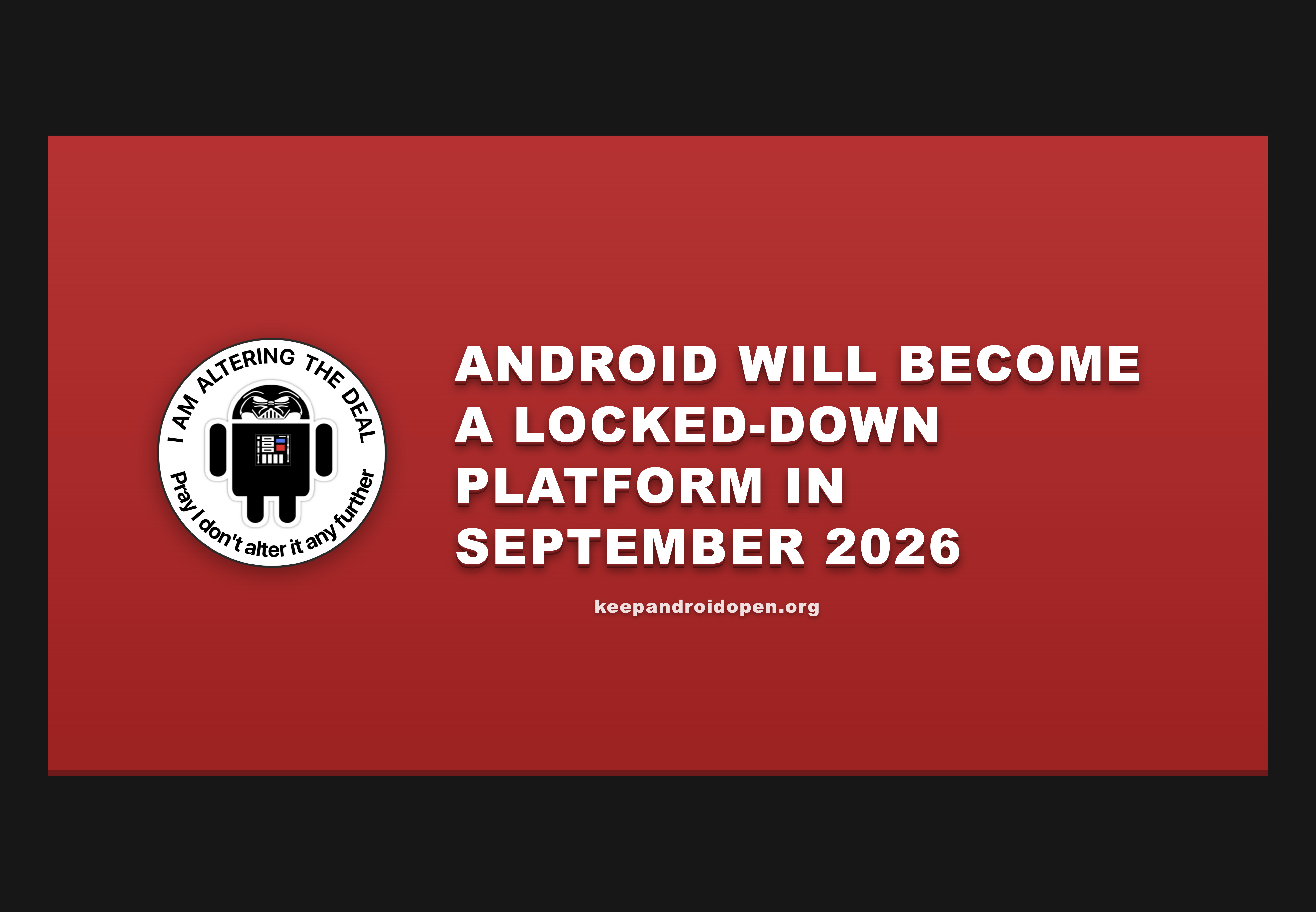
If you haven’t seen this yet, Google is planning to require mandatory developer identity verification for all Android apps, including apps distributed outside the Play Store, taking effect September 2026. This affects every independent and open source Android developer directly.
This is not just about the Play Store. After September 2026, on any certified Android device, applications from unverified developers will be blocked by default. The only proposed bypass, the “advanced flow”, exists only as a blog post and has not appeared in any beta, dev preview, or canary release. No one outside Google has seen it.
The community has been fighting back at keepandroidopen.org:
- Read the full breakdown of what this means
- Sign the open letter (organisations only)
- Contact your national regulators — contacts listed by country on the site
- Add the countdown banner to your project
September 2026 is closer than it looks. The time to push back is now.
I’ve treated a couple on a Fairphone 4, I’ve owned dsupported devices and I’m enamored, but there are some pros and cons, I highly suggest helping your distros and DE of choice to advance the daily drivability of mobile Linux offerings.
PostmarketOS is a bit annoying because of the mainlining process., but worth considering, specially if you’re a developer, or don’t mind tinkering with kernel configs, OR if you have a phone that is already supported. You got the Alpine repos, plus Flatpak, and Waydroid. (sidenote fairphones need some work, please send help if you can)
Mobian is similar to postmarketOS, but there’s Deloitian which can help adaption, although it uses Halium. Debian repos and Flatpak and Waydroid are available too.
Ubuntu Touch also uses Hailium, but is a great option for first timers, its easier to port to devices, and has a lot of devices supported and more in development/testing. But, also offers a vast versatility for running applications, not sure if more than the rest, though… (OpenStore, Waydroid, Libertine Containers for Ubuntu Repos+PPAs, no Flatpak though)
SailfishOS also uses Hailium, and is a continuation of Maemo and Moblin, and although its not FOSS, its more customizable than UT, and has more keyboard and sync options than most. If your device isnt officially supported you can still run android via Wayland (like all distributions here) this uses zypper btw, also no current flatpak, and has OpenRepos and Chum Repo.
There’s also Manjaro Mobile, which means there’s also Arch Mobile. There’s Fedora PocketBlue, its brand new, but stable in some devices.
As for Mobile Environments; Phosh is most common and I can’t complain, although I don’t enjoy gnome, its been in development for long enough that I’ll admit, its my preferred environment, despite needing another app to theme Qt apps.
GNOME Mobile is suppose to be mainline but, felt more limiting than Phosh, which has been running for longer. I didn’t try this much.
KDE Mobile, JFC I want to love it, but it currently still needs work, the Akonadi alternative wasn’t ready when I tried it, its very close to how Android works, and is the most customizable of the bunch. Again, if you can, send help for development.
Lomiri (UT) can technically be installed in any distroes, it has probably my favorite implementation of a status bar, there’s not much wrong with it, but I haven’t tested it outside of UT.
Lipstick, SailfishOS proprietary fork of NemoMobile, is beautiful and feels nostalgic to what old phones would’ve evolved into has we not have this duopoly. Its closed source so, you can’t contribute, but…
NemoMobile is in active development, and also prefers openSUSE as a base, I suggest checking them out and maybe contribute if it interests you.
There are more but I haven’t tried them.
My personal favorite were PostmarketOS, andSailfishOS. But I’d give someone Ubuntu Touch (or SFOS) for beginners, or Mobian for not-so-beginners.